How much does dental software cost in 2026
The first price is not the price. These are the five costs that usually appear later.
By Dentistes team
The question is not how much dental software costs. The question is how much the software your clinic actually needs costs, with the team you have today and the team you will have in two years.
The market has three models: per user, per module and a flat fee per clinic. Each one follows a different logic. Comparing only the first number is the fastest way to get it wrong.
The three pricing models
| Model | How it is calculated | When the bill usually grows |
|---|---|---|
| Per user | A fee for every person with access | Every new hire |
| Per module | A base + WhatsApp, signature, reports or reminders | Every feature you enable |
| Flat fee | One price per clinic, users and patients included | Only if you change plan |
The per-user model can make sense for a solo professional. For a clinic with reception, two dentists and a hygienist, the multiplication starts to hurt. The per-module model has the same issue: the final bill depends on how many pieces you need.
The costs that are not on the pricing page
- Setup and implementation: some providers charge for onboarding or initial training.
- Data migration: moving records and appointments may be billed by hour or by volume.
- Additional users: the fee rises when an assistant or administrator joins.
- Modules: WhatsApp, digital signature, reminders or reports are sold separately.
- Commitment: a 12- or 24-month contract limits your ability to leave if the product does not fit.
- Priority support: phone access or fast responses are sometimes an extra.
Not all of these costs are bad. What matters is knowing them before you sign and adding them to the price you compare. Software at €49/month with a €300 setup and €500 migration does not cost €49/month in year one.
Example with three people
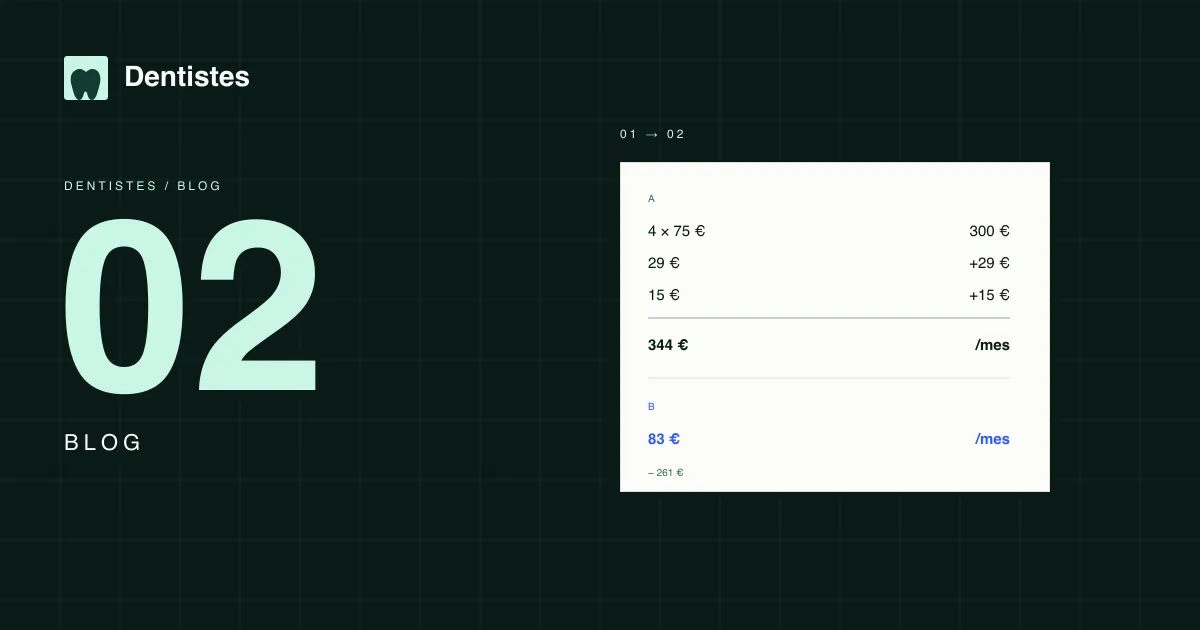
Imagine a clinic with reception, two dentists and a part-time hygienist. Four people access the system. We compare a per-user model at $75 USD/month with a flat fee of $18.50 USD/month, adding WhatsApp and digital signature in both cases.
| Item | Per user | Flat fee |
|---|---|---|
| 4 users × $75 | $300/month | — |
| Fee per clinic | — | $18.50/month |
| $20/month | $20/month | |
| Digital signature | $10/month | $10/month |
| Monthly total | $330/month | $48.50/month |
The difference is $281.50/month, or $3,378 a year. This is an illustrative example: every provider has its own prices and terms. But the logic holds: when the price depends on people, team growth becomes a cost.
Five questions before comparing
- How many people will access the system over the next 24 months?
- Which features do you need on day one and which can wait?
- Are setup, migration and training included?
- Is there a minimum term? What happens if you cancel early?
- Can you export all your data if you decide to change?
If you ask every provider these questions, the comparison stops being a race between fees and becomes a product decision. That is where an independent clinic can choose with judgement.
Calculate what you would pay with your team
See the flat price and compare it with your current bill. No sales calls and no commitment.
See pricingUpdated: 12 November 2026
Back to blog